

Make MPC Keygroups From Your Samples
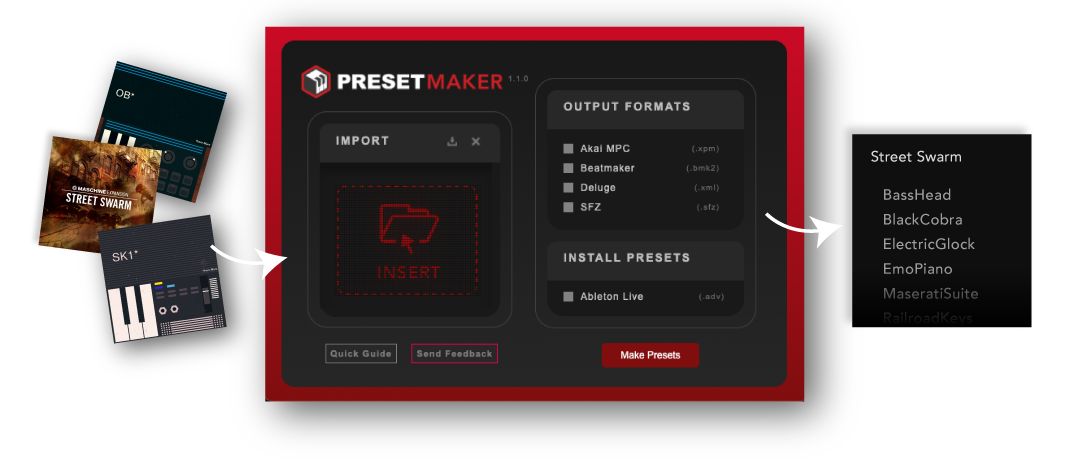
Building multi-sample instruments by hand is a pain, and doing it on the MPC itself is worse. Preset Maker turns your Sample Packs and Maschine Expansions into playable melodic keygroup instruments, organized and ready to transfer. Your one-shots get grouped by category at the same time.
$29 one-time purchase. No subscription.
Three steps to a folder of MPC keygroups
Import Sample Libraries
Drag and drop your sample packs and instrument folders.

Choose Output Formats
Pick MPC keygroups, or any of the other formats.
Make MPC Keygroups
Keygroups are built and named, ready to transfer.
Keygroup instruments, one-shot presets, and previews
Multi-samples become keygroups
Your multi-sample audio files are spread across the keyboard as playable MPC instruments.
One-shots become One-Shot Presets
Folders of one-shots are grouped into their own keygroups by category, spread across the keys so they can run past a single bank of pads.
Accepts Maschine Expansions or other Sample Packs
Drop in an Expansion or any sample pack and let the app find what it can use.
Audio previews
Every keygroup is written with a preview file, so you can hear an instrument in the MPC browser before you load it.
Not just MPC
The same libraries also make presets for Ableton, Beatmaker, Deluge, FL Studio and SFZ. See everything Preset Maker makes.
Sample packs make two kinds of keygroup
Preset Maker sorts each pack automatically. Multi-samples become keygroup instruments, mapped across the keys. One-shot sounds are grouped together by category. Your keygroups are organized by pack, so they are easy to find on the MPC and play straight away.
Below is an example of what one pack might create.
Keygroup Instruments
Individual instruments, sampled from multiple notes, automatically mapped across the keyboard.
Example keygroup: “Soft Piano”
- Soft Piano B2.wav
- Soft Piano A2.wav
- Soft Piano G2.wav
- Soft Piano F2.wav
Keygroup instruments that pack made
- Soft Piano
- Rhodes Mk1
- Jazz Guitar
- Vibraphone
- Upright Bass
One-Shot Presets
One-shot samples, grouped by category. A pack’s synth one-shots become one preset, its guitars become another preset.
Example keygroup: “Synths”
- Saw lead D.wav
- Reese bass.wav
- Analog stab G#.wav
- Bass synth.wav
- Juno pluck C.wav
- Long pad.wav
- Moog chord Amin.wav
Individual one-shots (non multi-sample files) are spread across the keyboard in each preset. These are not pitched per note, they are each meant to play as their original sounds.
One-shot presets that pack made
- Synths
- Guitars
- Keys
- Vibes
- Loose Samples

Your Maschine Expansions make keygroups too
Maschine Expansions can be dropped straight into Preset Maker. Most Expansions will build multi-sample keygroup instruments and group their one-shots into One-Shot Presets, ready to transfer to your MPC.
Important: not all Maschine instruments convert.
Only the instruments an Expansion ships in Samples/Instruments become multi-sample keygroups. One-shots are unaffected, and every Expansion still makes One-Shot Presets.
How the keygroups are created
Preset Maker knows how most sample packs and multi-samples name their samples. Below are some examples of how it reads the filenames.
Multi-sample files: instrument, note, octave
for example
The octave has to come straight after the note, so Soft Piano B♯2.wav works and Soft Piano B♯ 2.wav does not. Most packs are already named this way. Files that use MIDI note numbers instead of note names work too.
Several velocities per note
If a note was sampled at more than one velocity, keep the name identical and put the velocity on the end. The MPC gets real velocity layers out of it.
Number them by layer (V1, V2) or by MIDI velocity (V65, V95). Either works, as long as it’s consistent across the instrument.
One-shots: it’s the folder name that matters
One-shots don’t need note names. The app reads the folder they sit in, so a folder called “Chords” becomes a Chords keygroup and a folder of guitar one-shots becomes a Guitar keygroup.
Each one is spread across the keyboard rather than a single bank, so a big folder isn’t capped at sixteen sounds. You can edit the Keywords list under One-Shot Presets in the preferences at any time, so the grouping follows the categories you actually use.
Where your keygroups are created, and how to get them on the MPC
Everything is written to one folder on your computer, sorted by pack. Nothing is scattered, and nothing is installed anywhere you have to go hunting for.
Copy that pack folder onto an SD card or USB drive, or into your MPC’s own storage, then browse to it on the MPC and load a keygroup like any other program.
What you need before you start
Any modern Akai MPC running MPC OS 2 or MPC OS 3, hardware or software, including MPC Beats and Akai Force. Keygroup programs are a standard MPC format, so if your MPC loads instruments, it loads these.
Multi-sample files need the instrument name, then the note, then the octave, with nothing between the note and the octave. Most commercial packs already are. This is the one thing that decides whether an instrument builds.
One-Shot Presets are built from your folder names, so a pack that separates its kicks, chords and vocals has everything it needs. A single folder of unsorted one-shots gives the app nothing to group by.
Only the instruments inside Samples/Instruments can be rebuilt as keygroups. That is a limit of how Expansions are packaged, not of the app.
Preset Maker runs on Apple Silicon Macs and on Windows 10 and 11. An older version is still available for Intel Macs, but it isn’t updated anymore.
Not affiliated with Akai, Native Instruments or Samples From Mars.
.xpm drum programs from your sample packs, that’s my other app. See how to make MPC drum kits →
MPC keygroup questions
Does this work with MPC Beats?
Yes. MPC Beats reads the same keygroup programs as the hardware, so the presets load there too.
Do I need MPC OS 3, or does OS 2 work?
Both work. Keygroup programs have been part of the MPC format since well before OS 3, so nothing here depends on being up to date.
Do I need my computer once the presets are made?
No. Preset Maker builds the keygroups on your computer, and after you copy them across they live on the MPC like anything else. A standalone MPC plays them with nothing plugged in.
Why did some of my samples not turn into an instrument?
Almost always the filenames. A multi-sample instrument is built by reading the note and octave out of each filename, so a file that does not carry them cannot be placed on the keyboard. Files that use MIDI note numbers instead of note names work as well.
Does it handle velocity layers?
Yes, up to four layers per note, which is what an MPC keygroup holds. Name the velocity in the filename alongside the note, either by level or by MIDI velocity number, and the layers are mapped for you.
Will my Maschine Expansions convert?
The melodic instruments will, as long as they live in the Expansion’s Samples/Instruments folder. Anything packaged elsewhere in the Expansion is not something the app can rebuild.
Is this the same as making MPC drum kits?
No, and they are two different apps. This page is about melodic keygroup instruments. Drum programs, where each pad holds one sound, are what Kit Maker builds.
Start Making MPC Keygroups
$29 one-time purchase. No subscription. · For Mac & PC